Bill.
The Snider-Enfield Bullet is a Pritchett based bullet. The plug was made from ceramic rather than boxwood however, a much more reliable material for the purpose... but Pritchett based, it is!
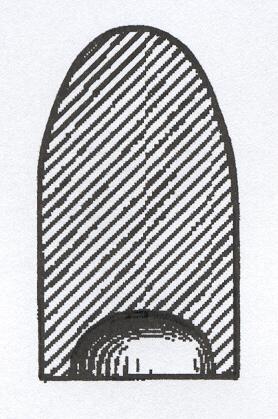
The early swagged, paper wrapped shallow based pure lead Prictchett bullet that used no base plug illustrated above, was replaced shortly after the Indian Mutiny in 1852 with the base plugged Pritchett pictured below...
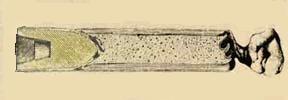 A section through the as issued .577" Enfield-Pritchett cartridge,(1855). The infantryman would tear off the top of the paper cartridge with his teeth and pour the gunpowder inside down the gunbarrel. After ramming the bullet home, he would insert a percussion cap in the nipple ready to fire. The bullet originally had a beech or clay "plug" in the hollow base to help it expand when fired.
 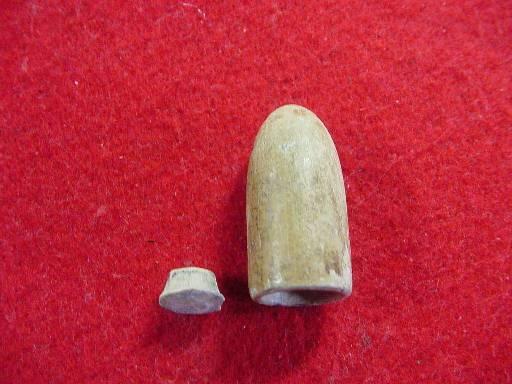 A dropped Civil War Enfield Pritchet bullet with conic wooden base plug... the plug has shrunk a bit over the years...
 The man who did the seminal work on the experimental Enfield cannelured Pritchett based bullet was a man named
James Henry Burton who was the chief engineer at Enfield from 1855 to 1860. His whole deal was to make the Pattern-Enfield bullet simple to load and incredibly accurate without the paper...
The fruit of his labor laid semi-fallow when he left Enfield in 1860 to head the armory in Macon Georgia during the war between the states... The bullet design was in experimental production for the Pattern-Enfields just before he left however, and was later picked up and used in the Snider.
The tapered boxwood plug in the nose, and the tapered ceramic plug in the base both stuck out of their respective cavities a tad. When pressure was applied with the ram rod it caused this cannelure lubed experimental soft lead alloy bullet to expand at the skirt and at the forward driving band when pressed sufficiently against the powder. The latter was more of a forward driving bulge actually. This expansion occured when 25 to 30 lbs. of ramrod pressure was applied ramming the bullet home.
In practice the tapered boxwood nose plug caused only a very small amount of expansion, however the tapered base plug shoved the skirt out into the rifling nicely, and the exploding powder did the rest.
The old smooth sided, lubed paper patch covered, boxwood plug cavity based, Pritchett bullet was nothing more than the test bed for what Burton was doing, and fortunately before he left Enfield his improvements were on their way to being mass-produced and were... Now I'm certain that Pritchett, Lovell, Metford, and others may have had input here, but the driving force was Burton... There were changes made to the bullet throughout the Sniders service life, and I'm sure that many warehouses of early Enfield bullets were melted down to make them... BUT, the bullet as it was produced and used in the Snider-Enfield, was originally created for use in the Pattern Enfield, and remained unchanged from Burtons basic muzzle loading Enfield design.
Burton also invented the so-called "Mini� Ball" that we are all familiar with, that are fired by the boatload on ranges throughout the world every year... It should be called the "Burton ball"... 'cause there ain't nothing Mini� about it. There's no semi-circular iron cup in a parallel sided hollow base... If you look at a cross section of Mini�s ball it looks like a ball sitting on a short section of same diameter tube... The bullet we fire every weekend was, and still is Burtons own... Unfortunately, Burton was on the defeated side at the end of the war between the states and received no credit for that one as well...
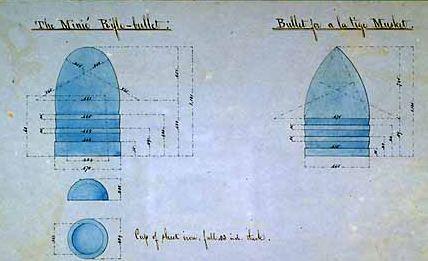 The photo above is of an original drawing by James Henry Burton, the father of the "Burton Ball" which was used during the War Between The States on both sides. On the left is the bullet designed by Claude Mini�, *the Mini� Ball* including its iron cup that fit into the straight walled hollow base for expanding the skirt. On the right is the Tige version for the smooth-bore musket. (sic) It was a soft lead solid. Burton's version, (not illustrated since we all are*quite* familiar with the Lyman 575213 which is a Burton Ball), required no base plug and had a very thin skirt which expanded by powder ignition pressure only.
 It was found that the hollow nose, or when nose plugged with a lighter material like boxwood gave the bullet a little better balance and stability in the slow twist rifling, but it was also found that by shortening the bullet a tad, the same or better result was achieved.
As far as exploding bullets... I know that Jacobs was experimenting with those. However, I would think that a 58 caliber hollow point made of soft lead alloy racing at you at 1100fps would be quite explosive... if one was unlucky enough to get hit with it ...(chuckle)...